
P. Shravan Kumar
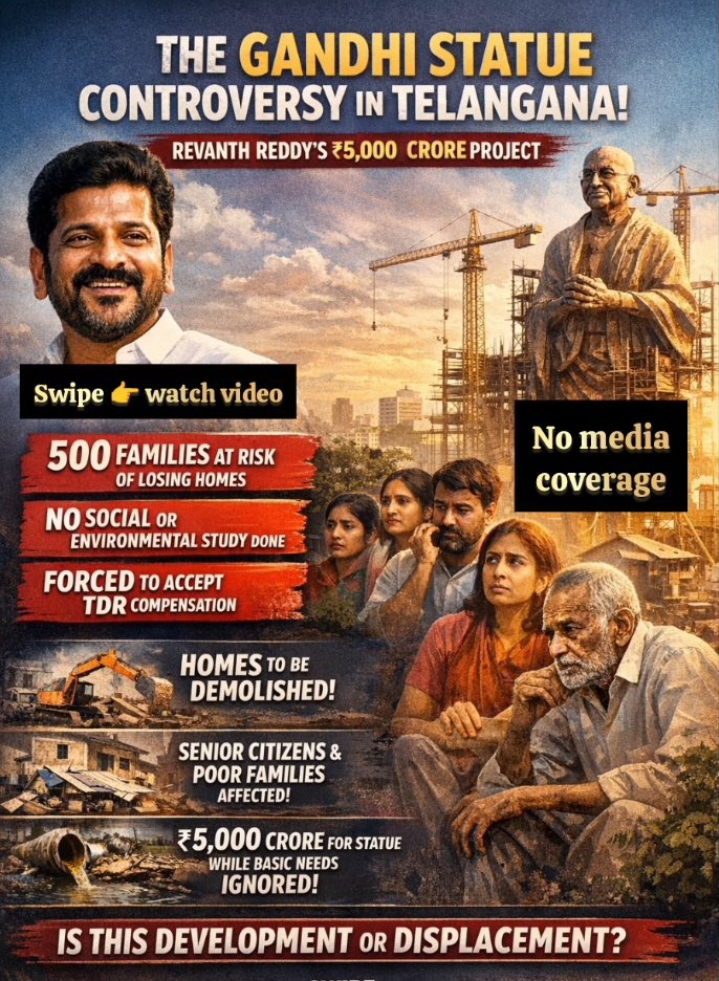
Hyderabad, Telangana — A major political and social storm has erupted after the Telangana Government’s Musi Riverfront Development Project moved forward with plans that could see around 450–500 families displaced from their homes to make way for a proposed Mahatma Gandhi statue project worth ₹5,000 crore. The decision, part of a broader river rejuvenation and urban redevelopment plan along the Musi River, has drawn widespread protest from residents, opposition parties, and civil society groups.
What the Government Has Proposed
Under the Musi Riverfront Development initiative, authorities have identified a section of the river’s buffer zone near Bapu Ghat as the site for a grand Gandhi monument and associated redevelopment works intended to boost tourism, culture, and environmental restoration in Hyderabad. The plan involves acquiring land from residential areas, including the Madhu Park Ridge Apartments, where approximately 450 families currently live. Residents have received notices to vacate their properties, with compensation being offered in the form of Transferable Development Rights (TDR) instead of outright cash settlements.
According to government notices, property owners in flood-prone and buffer zones along the river — including plots close to the proposed Gandhi statue site — have been invited to surrender land voluntarily in exchange for TDRs that can be used for development elsewhere.
Residents Resist Evictions
Affected families, primarily from the gated community in Bandlaguda Jagir, argue that the notices to vacate their homes — built with their lifelong savings — are deeply unjust. Many fear that TDRs may not be financially viable in the current market and do not adequately offset the loss of permanent housing. Protests have been held, with residents stating they are ready to fight the orders legally and politically. Some have even invoked powerful emotional rhetoric, expressing that demolition of their homes would be tantamount to destroying their life’s work.
Residents have emphasized they are not opposed to Gandhiji’s legacy or respectful memorials but strongly reject losing their homes in the process. “Vikas ka matlab vinash nahin” (“development should not mean destruction”), protesters have stated.
Political Backlash Widens
The opposition has seized on the issue to criticize the ruling Congress government. The Bharat Rashtra Samithi (BRS) has accused Chief Minister A. Revanth Reddy of undertaking the project without a detailed project report (DPR), environmental clearances, or adequate planning, calling the move a “real estate agenda” that unjustly displaces poor citizens.
The BJP’s Telangana unit has also condemned the actions, describing forced evictions as “inhumane” and urging the government to follow legal protocols, ensure transparency, and provide dignified rehabilitation for affected families.
In response, state Congress leaders have pushed back against some opposition claims about the exact positioning of the monument relative to residential structures, insisting that the project will proceed through standard procedures including environmental and land-use clearances, and that affected residents will receive fair compensation.
Broader Context and Public Debate
The Musi Riverfront project is part of a larger urban renewal effort aimed at revitalizing key segments of Hyderabad’s river ecology, public spaces, and cultural landmarks. However, critics argue that the scale of expenditure — with a monumental statue alone estimated at ₹5,000 crore — represents a misallocation of public funds, especially when significant portions of the population face housing shortages and financial strain.
Supporters of the project underline the potential for boosting tourism, creating public spaces, and honoring Mahatma Gandhi’s legacy, but there remains significant public debate over priorities, financial transparency, and the human cost of large-scale urban redevelopment.
What Happens Next
The government is expected to continue consultations with stakeholders, potentially revise compensation mechanisms, and advance planning for clearances and project details. Affected residents have indicated intentions to pursue legal remedies, while political parties prepare to raise the issue in legislative sessions and public forums.
This unfolding controversy underscores the complex intersection of heritage, development, urban planning, and citizens’ rights in one of India’s fastest-growing metropolitan regions.
(The views expressed are solely those of the author.)


