Writer: Abdhesh Jha
Mother is the foundation of the universe, and without the Mother, liberation from the world is not possible. There is no being without a mother; hence, the Mother of all mothers is none other than Goddess Durga herself. “Mother” means the original source from which all creation has arisen. A child may forget the mother, but the mother never forgets her child.
Just as a pot made of clay may not remember that its origin is clay, the clay always knows that although it has taken the form of a pot, in essence, it is still clay. Similarly, the soul’s true nature is inseparable from the Supreme Mother. The Mother presides over all the states of her children—waking, dream, deep sleep, and the transcendental state (turiya). Without her grace, no being can cross beyond these states. The seeker who transcends them and abides in the Self truly experiences the essence of the Mother.
On the auspicious occasion of Navratri, former Justice of Patna High Court, Shri Rajendra Prasad, remarked:
**“At the beginning of the Durga Saptashati, Lord Shiva tells Parvati—
देव्याः अष्टशती विद्या गुप्ता कैश्चिद् विनेयकैः।
अहं तु सर्वसारार्थं वक्ष्यामि सप्तश्लोकीकाम्॥
Meaning: The essence of the entire Durga Saptashati is contained in seven verses. If a seeker is surrounded by sorrow, fear, danger, or worldly needs, by reciting the ‘Saptashloki Durga’, the Mother’s grace is swiftly attained.”**
This clearly shows that the Mother not only fulfills worldly desires but also removes obstacles in life. The story of King Suratha and the merchant Samadhi in the 13th chapter of the Durga Saptashati is a living example of this truth. King Suratha was sorrowful after losing his kingdom, while the merchant Samadhi, disillusioned with his family, was overwhelmed with renunciation.
Both undertook penance to worship the Mother. Pleased, the Goddess said:
“Varam vṛṇudhvaṁ bhadraṁ vo yadavadya mano’bhilaṣitam”
(“Choose your boon, O blessed ones, whatever your heart desires.”)
The king wished for the restoration of his kingdom, while the merchant desired liberation. The Mother granted both wishes: King Suratha was reborn as a universal emperor and ultimately attained liberation, while the merchant immediately received self-realization and freedom. This story proves that Goddess Durga is the giver of both worldly fulfillment and liberation.
In truth, the Mother is the presiding power of both knowledge and ignorance. The Devi Mahatmya declares:
ॐ ज्ञानिनामपि चेतांसि देवी भगवती हि सा।
बलादाकृष्य मोहाय महामाया प्रयच्छति॥
Meaning: Even the hearts of the wise can be drawn into delusion by the Mother, the Great Illusion (Mahāmāyā). Yet, she keeps the realized soul free from bondage.
This is her primal role—being the sovereign of both Maya and Shakti. She propels beings into the flow of worldly life so that they may fulfill their noble desires, cultivate detachment, and finally move towards liberation.
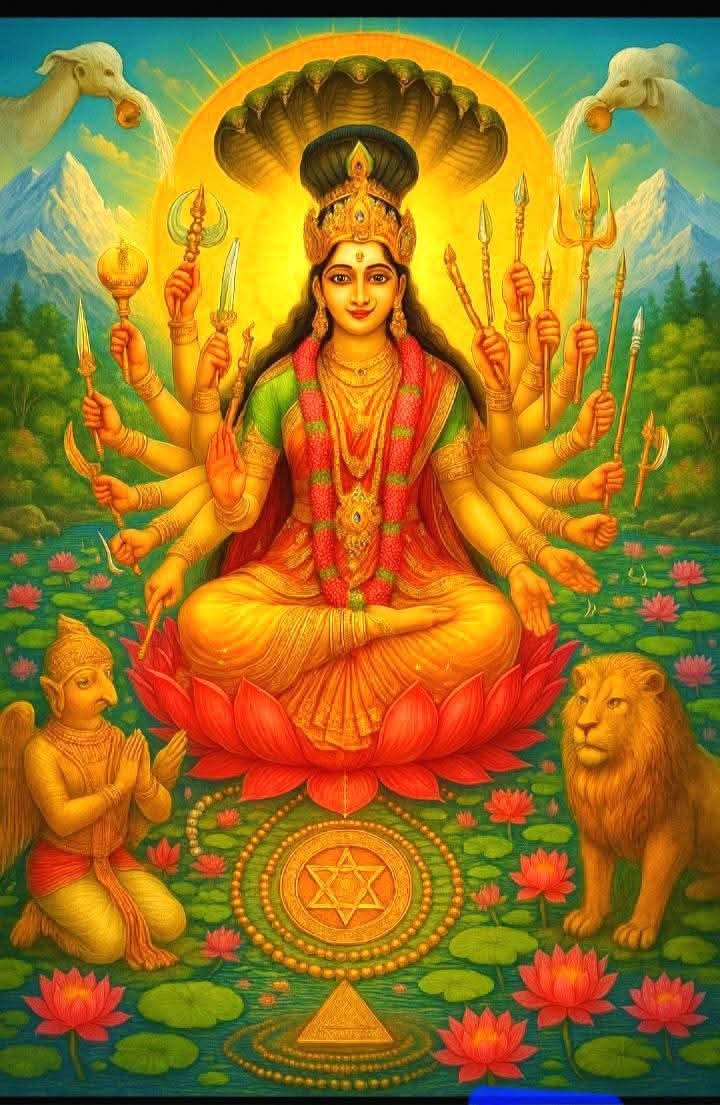
The form of Mother Durga is threefold:
At the beginning, she is Māyā-svarūpiṇī (the one who impels beings into worldly existence).
In the middle, she is Kalyāṇakāriṇī (the one who bestows auspiciousness, strength in intellect, compassion, forgiveness, wealth, and all aspects of life).
In the end, she is Mokṣadāyinī (the giver of liberation, fulfilling the final aspiration of the seeker and granting supreme attainment).
Thus, Mother Durga is the fulfiller of desires, the protector of life, and the bestower of liberation. She guides the soul from the beginning of life until its ultimate end. She is Māyā, she is Shakti, she is Compassion, and she is the Supreme Brahman—who grants final liberation.