
- Abdhesh Jha
Patna, October 13, 2025 :: Agriculture is the backbone of India’s economy. More than half of the country’s population depends on farming for their livelihood. However, agriculture is entirely dependent on weather and climate uncertainties. Timely rainfall, proper temperature, and favorable natural conditions ensure a good harvest. In this context, the India Meteorological Department (IMD) has become a crucial institution — benefiting both farmers and the government. Its accurate forecasts and timely warnings play a vital role in enhancing agricultural productivity and ensuring safety.
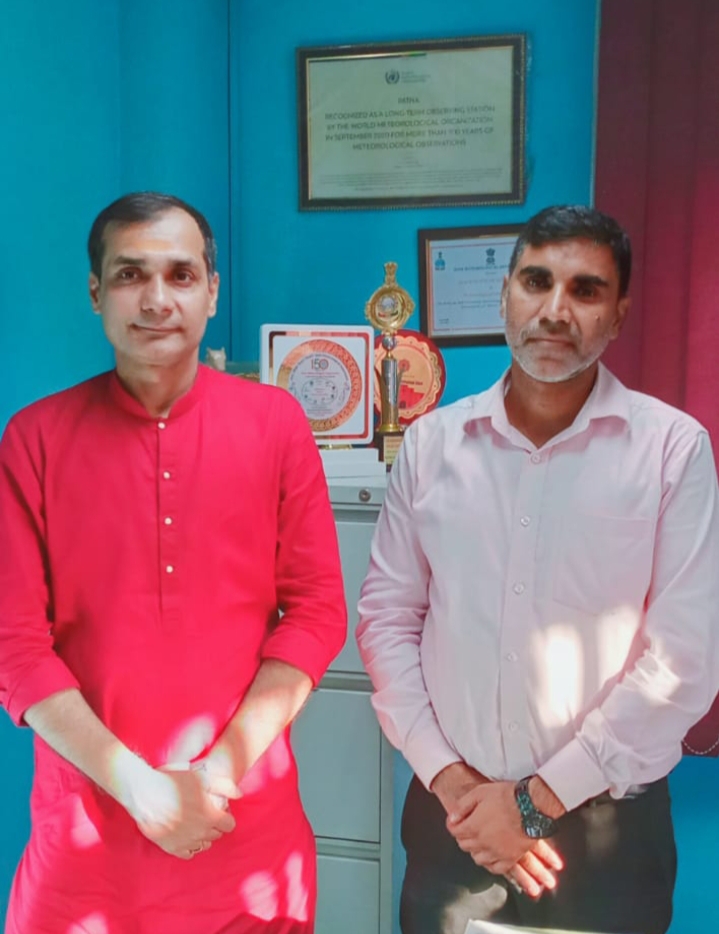
According to Ashish Kumar, Scientist-D, IMD Bihar (Patna) —
“Forecasting has become significant across all sectors today. It is essential to alert people and authorities in advance through accurate and early warning systems — whether it’s a heatwave, flood, or any other disaster or health-related emergency.”
IMD’s Role in Supporting Farmers
For farmers, weather information is not just news — it’s the foundation of their livelihood. IMD provides daily, weekly, and seasonal forecasts, enabling farmers to make better and science-based agricultural decisions.
Crop Planning and Sowing:
Based on monsoon predictions, farmers can decide which crops to plant and in what quantity. In case of low rainfall forecasts, they can choose short-duration or drought-resistant crop varieties.
Irrigation and Fertilizer Management:
Rainfall forecasts help farmers schedule irrigation efficiently, saving water and optimizing fertilizer use.
Disaster Protection:
Mobile applications like Meghdoot, Mausam, and Damini provide timely alerts for lightning, cyclones, heavy rain, and hailstorms. Farmers can take preventive measures to protect crops, livestock, and property.
Income Stability:
Reduced crop losses due to timely weather warnings help stabilize farmers’ income and reduce their dependence on loans or relief packages.
IMD’s Role in Government Planning
For the government, weather and climate information is crucial for policy formulation, disaster management, and public welfare programs.
Disaster Management:
In flood-prone states like Bihar, Assam, and Odisha, and drought-prone regions like Maharashtra and Karnataka, IMD’s early warnings enable governments to arrange relief materials, evacuation, and rehabilitation on time.
Agricultural Policies and Schemes:
Schemes like the Pradhan Mantri Fasal Bima Yojana (PMFBY) rely on IMD data for assessing crop losses. Similarly, irrigation, seed distribution, and fertilizer subsidy programs are guided by weather forecasts.
Food Security:
Long-range monsoon forecasts help the government plan food grain storage and distribution, ensuring national food security.
Climate Adaptation:
Amid climate change challenges — such as heatwaves, erratic rainfall, and storms — IMD supports governments in developing long-term mitigation and adaptation strategies.
IMD: A Pillar of Rural Life and Agricultural Growth
The India Meteorological Department is no longer just a weather-reporting institution — it has become an integral part of rural life and agricultural planning. It empowers farmers to make informed decisions and assists the government in disaster management, food security, and policy development.
In a nation where agriculture remains the cornerstone of livelihood, IMD’s role directly links to productivity, rural prosperity, and economic stability. By strengthening both farmers and policymakers, IMD is helping India’s agriculture become more resilient to climate change.
IMD’s Role in Urban Bihar
Just as IMD supports rural communities, its role in urban Bihar is equally vital for citizen safety, public health, and infrastructure planning.
Urban Flood Management:
Cities like Patna, Darbhanga, and Bhagalpur often face waterlogging and urban floods during monsoon. IMD’s heavy rainfall alerts allow municipal bodies and disaster management departments to prepare in advance — by cleaning drains, setting up pumping systems, and alerting citizens.
Heatwave and Health Safety:
In recent years, heatwaves have become a major threat in cities like Patna and Gaya. IMD’s early warnings enable health departments to prepare hospitals and help citizens follow Heat Action Plans. Similar alerts during cold waves help protect vulnerable populations.
Air Quality and Pollution Control:
Air pollution is a growing concern in cities such as Patna and Muzaffarpur. IMD’s Air Quality Forecasting System provides accurate pollution-level data, helping the government manage traffic and industrial emissions while guiding citizens with health advisories.
Urban Planning and Infrastructure:
Weather and rainfall data are essential for new roads, bridges, and smart city projects. IMD’s data supports urban development departments and city planners in designing sustainable and climate-resilient infrastructure.
Energy and Transport Sectors:
Electricity demand in cities fluctuates with weather conditions — high during summer (AC/coolers) and winter (heaters). IMD’s forecasts help power companies manage load distribution. Similarly, airports, railways, and road transport authorities rely on weather alerts for safe operations.
Everyday Citizen Life:
Through apps like Mausam, Damini, and Meghdoot, citizens receive direct, real-time weather updates. Timely information helps people plan travel, work, study, and daily activities safely and efficiently.
While rural Bihar depends on IMD for farming and crop success, urban Bihar relies on it for safety, health, mobility, and infrastructure development.
In an era of rapid urbanization and changing climate, the India Meteorological Department stands as both — a shield for citizens and a guide for governments.
It not only forecasts weather but also shapes India’s path toward a secure, sustainable, and climate-resilient future.


