
By Shreekant Prasad
India’s economy in FY 2024–25 stood as a compelling example of resilience amid a turbulent global environment marked by geoeconomic fragmentation, high interest rates, and slowing global demand. Despite these challenges and a high base effect from the previous fiscal year, India maintained its position as the fastest-growing major economy, recording a real GDP growth of approximately 6.4%–6.5%, close to its decadal average.
This performance was underpinned by strong domestic demand, prudent macroeconomic management, and broad-based sectoral contributions spanning agriculture, industry, and services.
Macroeconomic Growth: Stability with Momentum
India’s real GDP growth moderated from 8.2% in FY24 to about 6.4%–6.5% in FY25, reflecting normalization after a high-growth year. Real Gross Value Added (GVA) also grew at 6.4%, indicating balanced sectoral performance.
Quarterly trends highlighted some moderation but overall stability:
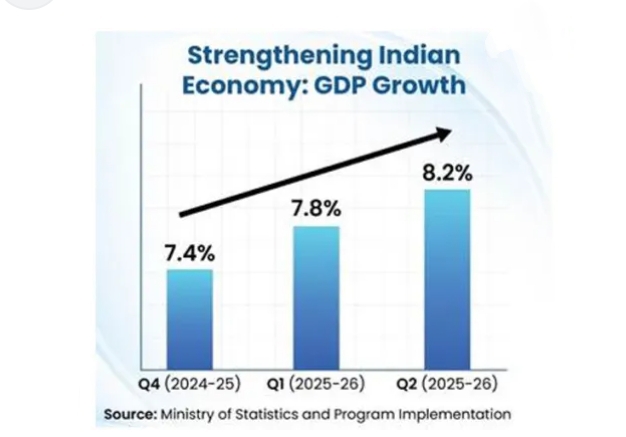
Q1 FY25: 8.44%
Q2 FY25: 6.71%
Q3 FY25: 6.16%
Q4 FY25: 6.22%
Early 2025 recovery: ~6.9%–7.3%
The trajectory reflects a rebound in rural demand, rising private consumption (up 7.3%), and sustained government-led infrastructure expansion.
Inflation and Financial Stability
India’s macroeconomic stability was reinforced by a controlled inflation environment and a robust financial system.
CPI Inflation declined from 5.4% in FY24 to around 4.6%–4.9% in FY25, with further softening into early 2025.
Inflation briefly dropped to 2.8% (May 2025) and even lower in subsequent months due to easing food prices.
Core inflation remained stable near 3.5%, suggesting limited underlying price pressures.
The banking sector showed remarkable strength:
NPAs fell to a 12-year low of 2.6%
CRAR stood strong at 16.7%
This stability enabled credit expansion and supported capital expenditure growth.
Sectoral Performance: A Rebalanced Growth Story
FY 2024–25 marked a structural shift in sectoral contributions, with agriculture regaining momentum and services maintaining dominance.
Agriculture: A Strong Comeback
After a modest 2.7% growth in FY24, agriculture rebounded to around 3.8%–4.6%.
Key drivers:
Record Kharif foodgrain production: 1647.05 LMT (up ~5.7% YoY)
Improved monsoon conditions
Strengthening rural consumption
Industry: Moderation with Bright Spots
Industrial growth moderated to 6.2%, compared to double-digit growth earlier.
Manufacturing stabilized around 6%–6.5% due to weak global demand
Construction remained a standout performer with ~10% growth, driven by government CAPEX
Manufacturing PMI stayed in expansion (around 55)
Services: The Growth Engine
Services continued to dominate, contributing ~55% of GVA and growing at 7.2%–7.5%.
Key highlights:
Services exports grew ~12.8%
Strong performance in IT, telecom, finance, tourism, and trade
India emerged as a global leader in digital services exports
External Sector: Strength Amid Global Disruptions
India’s external sector remained robust despite trade disruptions and geopolitical tensions.
Total Exports: $825.25 billion (+6.05%)
Services Exports: $387.54 billion (+13.63%)
Merchandise Exports: $437.70 billion (marginal growth)
Current Account Deficit: ~1.2–1.3% of GDP
The merchandise trade deficit widened but was offset by a strong services surplus.
Other key indicators:
FDI Inflows: $81.04 billion (+14% YoY)
Forex Reserves: $640+ billion (covering ~11 months of imports)
India continued to attract global capital, led by inflows from Singapore and Mauritius, with Maharashtra emerging as the top destination.
Fiscal Management and Policy Support
The government maintained a disciplined yet growth-oriented fiscal stance.
Fiscal Deficit: Reduced to 4.7% of GDP (from 5.6%)
GST Collections: Consistently above ₹2 lakh crore/month
Capital Expenditure: Continued strong push, crowding in private investment
Policy initiatives such as the PLI (Production Linked Incentive) scheme:
Attracted investments worth ₹2 lakh crore
Generated over 12.6 lakh jobs
Public investment played a crucial role in sustaining economic momentum.
Investment Climate and Financial Markets
Gross Fixed Capital Formation (GFCF): ~32.9% of GDP
Stock market capitalization reached 136% of GDP, reflecting investor confidence
Private investment is improving but still trails public sector momentum
Challenges Ahead
Despite strong fundamentals, certain structural challenges persist:
Private Investment Gap
Private sector capex has yet to fully match public investment levels.
Global Uncertainties
Trade protectionism and supply chain realignments pose risks.
Dependence on Imports
Particularly in electronics and solar equipment.
Climate and Monsoon Risks
Erratic rainfall could impact agriculture and food inflation.
Outlook for FY 2025–26
India’s growth outlook remains optimistic:
Projected GDP Growth: 6.3%–6.8%
Nominal GDP: ₹357 lakh crore (~$3.96 trillion)
Key growth drivers going forward:
Continued infrastructure investment
Ease of Doing Business reforms (EoDB 2.0)
Strengthening rural demand
Cooling food inflation
India’s economic performance in FY 2024–25 highlights a rare combination of growth, stability, and structural resilience. Anchored by strong domestic fundamentals, prudent policymaking, and a diversified growth base, the economy has successfully navigated global uncertainties.
While challenges remain, the foundation for sustained 7%+ growth in the medium term appears firmly in place, positioning India as a central pillar in the evolving global economic order.


