— Dr. Shailendra Mohan Jha
Patna: 5 January 2026 :: The ruling establishment understands voters only as voters. For them, we are merely numbers in the electoral process. Despite the fact that Maithili language speakers number in the crores, why does the ruling power not listen to the appeals of crores of Maithili speakers?
Social, Economic, and Political Role of the Maithili Language
There is an urgent need to understand the social, economic, and political role of the Maithili language. In society, the number of people who speak Maithili runs into crores. For this vast majority, speaking and understanding Maithili is natural and effective. The government itself acknowledges that learning and understanding in one’s mother tongue is simpler and more accessible. However, the critical question remains: what future does education in Maithili offer? What kind of employment opportunities are available to those who pursue B.A. or M.A. degrees in Maithili?
In reality, English dominates the employment landscape. This means that unless the government creates jobs specifically linked to Maithili as a subject, students of Maithili are left without viable career paths. Therefore, it is essential that Maithili be included as a subject in competitive examinations and that facilities be provided for taking examinations in the Maithili language. This must be ensured as a matter of policy. For this, a mass movement is required—one in which all Maithili speakers and learners participate—because their collective future depends on it.
In shaping such a movement, it is equally important to emphasize that Maithili is not the language of only the elite or traditionally dominant castes. Public trust will be built only when Maithili institutions genuinely include speakers from all sections of society. Institutions such as Chetna Samiti and the Maithili Academy must go beyond representation limited to Brahmins and upper castes like Jha, Mishra, and Thakur, and ensure representation of communities such as Paswan, Mochi, and others.
We must accept the reality that we live in an unequal, caste-divided society. When the large, marginalized sections of Maithili-speaking society receive respect and representation, they will speak Maithili with pride, study it, enter jobs connected with it, and—most importantly—because of their numerical strength, the government will be compelled to listen to their demands. For this to happen, a fundamental change in mindset is essential.
Limited Participation in Protests and the Growing Crisis
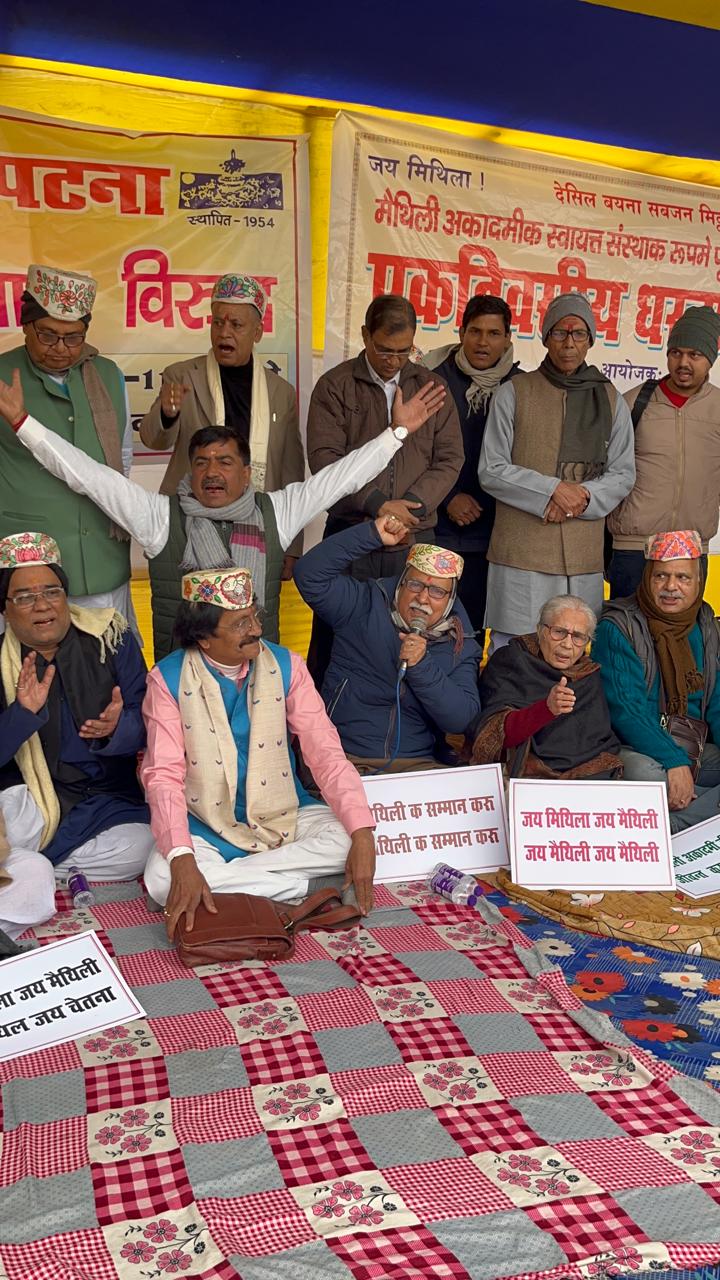
Why did only around 200 people participate in the protest? The reason is that those who study Maithili and seek employment through it do not yet perceive an immediate crisis. The lack of appointments in the Maithili Academy and the government’s neglect of the language are seen as merely symbolic issues. However, the reality is far more serious.
Gradually, all employment linked to Maithili—teaching positions, institutional roles, opportunities for literary recognition, and government awards for Maithili writers—will diminish. Institutions like the Maithili Academy will be reduced to symbolic existence, struggling merely to survive.
This is why it is crucial, at this very moment, for all teachers of Maithili, scholars, writers, and those who have attained administrative positions through Maithili to actively participate in such movements. Their own professional existence is tied to the survival of the Maithili language. This is a moment of crisis for Maithili and for Maithili speakers—a struggle for existence itself.
The ruling establishment is closely observing how much collective strength the Maithili-speaking population actually possesses. Hence, an immediate, united, and majority-based struggle is the need of the hour.
Political Strategy and the Eighth Schedule
My assessment is that granting Maithili a place in the Eighth Schedule of the Constitution was a well-thought-out political strategy. The Bharatiya Janata Party and the Rashtriya Swayamsevak Sangh sought, in a planned manner, to secure the votes of the educated elite of the Mithila region—particularly Brahmins and upper castes. By honoring the Maithili language, they successfully consolidated this vote bank.
The results are evident today: a majority of Brahmins and upper-caste groups in Mithila have become supporters of the BJP.
As a consequence, the ruling leadership in Bihar has shifted its slogans and focus toward Extremely Backward Classes and women. These groups in the Mithila region do speak Maithili, but they are largely uneducated, underrepresented in institutions, and absent from government employment. While their votes are sought, there is little concern for the protection and promotion of their language and culture.
Institutions like Chetna Samiti must recognize this reality: only when these majority groups are included in institutions and movements will the government take Maithili’s demands seriously. They constitute the real vote bank, and when their language-based demands are raised collectively, the government will be compelled to respond.
Therefore, the movement must take a dual form. Maithili speakers should not be limited to the educated elite alone; the movement must honor and include the common people—the numerical majority—by giving them space and dignity. They will connect with the movement only when studying Maithili leads to tangible employment opportunities. Hence, a focused movement demanding Maithili as a subject and medium in competitive examinations is essential.
Maithili writers, too, must bring about a change in perspective. An inclusive Maithili society—its people and their lived experiences—should become the starting point of Maithili literature.
Understanding the realities of vote-based politics, the mindset of the ruling class, and the direction of contemporary politics, the objectives and form of the Maithili movement must be clearly defined. The future of the Maithili language speakers must be envisioned through the Maithili language itself.
It is essential that Maithili institutions recognize, respect, and validate the contributions of the vast majority of Maithili speakers, and instill confidence in them that they are an integral part of Maithili language and culture. Only then will the majority of Maithils participate actively, perceive Maithili as their own collective vote bank, and move forward together in a sustained, united movement.
This important task—of changing mindsets—will take time. It must be pursued gradually, patiently, and continuously. Only then will the desired results emerge.
(Writer: Dr. Shailendra Mohan Jha, Ex Professor of Delhi University)