By Dr Shailendra kumar Pandey
The Aravalli Range, one of the world’s oldest mountain systems, extends across Rajasthan, Haryana, Gujarat, and parts of Delhi. It plays a crucial role as an ecological shield, preventing the eastward spread of the Thar Desert, supporting groundwater recharge, moderating local weather patterns, and maintaining biodiversity. Geologically rich, the range contains over 70 mineral types—including copper, zinc, lead, silver, tungsten, marble, granite, quartzite, mica, feldspar, graphite, and rare earth elements—many of which are commercially extracted to drive construction, industrial supply chains, renewable energy technologies, and defense applications.
The ongoing Supreme Court proceedings highlight the delicate balance required between resource development and conservation. On November 20, 2025, the Court accepted a committee-recommended uniform definition for Aravalli Hills and Ranges in the mining context: hills as landforms with an elevation of 100 meters or more above local relief (measured from the lowest encircling contour, including supporting slopes and associated features), and ranges as clusters of such hills within 500 meters of each other. This elevation-focused criterion sought to resolve longstanding inconsistencies across states and potentially restrict strict protections to higher features, while mandating a Management Plan for Sustainable Mining (MPSM)—prepared under bodies like the Indian Council of Forestry Research and Education (ICFRE)—before approving new leases.
The Judicial Backdrop and Its Market Signals
The Supreme Court’s recent actions in the Aravalli mining matter—rooted in long-running environmental petitions such as M.C. Mehta v. Union of India and T.N. Godavarman Thirumalpad v. Union of India—have created significant regulatory uncertainty for the sector. The Court’s November 2025 ruling introduced a new “100-meter above local relief” test to define Aravalli hills, potentially removing nearly 90% of low-elevation areas from strict protection and opening them to mining under a Management Plan for Sustainable Mining prepared by the Indian Council of Forestry Research and Education.However, the subsequent stay orders in December 2025 and January 2026 have imposed an interim freeze on new mining leases and renewals while an expert committee re-examines the definition.
Market reactions reflect this volatility: companies linked to Rajasthan’s marble and granite belts have seen fluctuating valuations, with some analysts issuing downgrades due to expected delays in approvals. If the Court ultimately mandates stronger sustainability norms—such as stricter reclamation rules and cumulative impact assessments—operational costs for compliant firms could rise by 20–30%. At the same time, tighter oversight may help curb illegal mining networks that currently divert revenues worth tens of thousands of crores annually.
Investment Risks and Opportunities in a Volatile Landscape The Supreme Court of India’s ongoing scrutiny of mining in the Aravalli Range—rooted in long-standing environmental litigation—has created a volatile regulatory landscape with significant economic implications. The November 2025 ruling, which applied a “100-meter above local relief” test, potentially removed nearly 90% of low-elevation areas from stringent protection, opening the door to regulated mining under a sustainability framework prepared by the Indian Council of Forestry Research and Education. However, subsequent stay orders have frozen new leases and renewals pending expert review, leading to uncertainty in markets, especially for firms operating in Rajasthan’s marble, granite, and industrial mineral belts. Economically, the Aravallis represent substantial untapped value: industry estimates place potential mineral wealth—including quartzite, mica, feldspar, graphite, and rare earth elements—at more than ₹40,000 crore. If regulatory conditions ease, Rajasthan’s mining revenues could rise by 15–20% over the medium term, supporting infrastructure and livelihoods for millions tied to the sector.For investors, the situation underscores critical ESG considerations. Companies with poor compliance histories face higher litigation and reputational risk, while those deploying sustainable technologies—such as drone surveillance and eco-restoration—may benefit from valuation premiums.
Social impacts remain equally significant: mining generates employment but often displaces vulnerable communities, leading to migration pressures and indirect economic strain. A balanced Management Plan for Sustainable Mining, with strong rehabilitation mandates and community safeguards, could unlock economic value while curbing illegal mining networks and ensuring long-term environmental and social stability.
Environmental Concerns: A Fragile Ecosystem under Siege
The Aravalli Range functions as a vital natural barrier, halting the eastward advance of the Thar Desert, facilitating significant groundwater recharge, moderating local micro-climates, and supporting rich biodiversity. However, decades of illegal mining, deforestation, encroachments, and urban expansion have severely degraded this ancient ecosystem, pushing it toward irreversible tipping points.
Key environmental threats include: Desertification and Accelerated Soil Erosion: unregulated quarrying has created numerous gaps and breaches across the range, allowing desert sands to encroach into fertile plains. This has led to widespread soil loss, reduced arable land, and intensified drought in semi-arid areas. Reports indicate that in southern Haryana, dozens of hills have vanished over recent decades due to mining activities, while forest cover in parts of the range has declined significantly. These changes have opened pathways for dust storms to reach the National Capital Region (NCR) and beyond, worsening air quality and accelerating desertification.
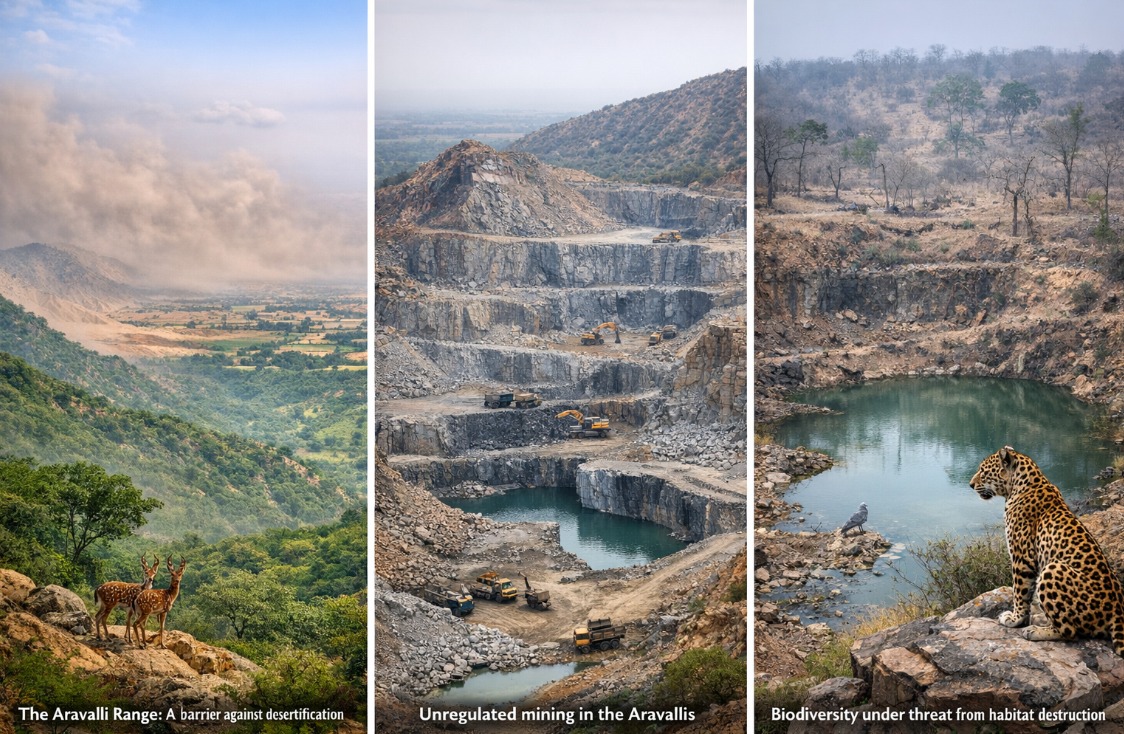
Figure: The Aravalli Range – A vital ecological barrier against desertification and a geologically rich zone under threat from unregulated mining and encroachments.Groundwater Depletion and Water Security Risks: The Aravalli’s fractured rocks act as a critical recharge zone, with an estimated potential of around 2 million liters of groundwater per hectare annually through natural percolation. Mining disrupts this process by puncturing aquifers, lowering water tables dramatically, and contaminating sources. This threatens agriculture in surrounding regions and urban water supplies in the NCR, where already stressed aquifers face further depletion. Dust and particulate pollution from operations further degrade air quality, contributing to respiratory health issues among local populations.
Biodiversity Loss and Habitat Fragmentation: The range is home to diverse flora and fauna, including leopards, striped hyenas, jungle cats, numerous bird species (over 300 recorded), and other wildlife. Mining blasts, deforestation, and habitat destruction have fragmented ecological corridors, increasing human-wildlife conflicts and endangering species survival. Biodiversity hotspots like the Asola Bhatti Wildlife Sanctuary face ongoing pressures from encroachments, abandoned mine pits (now toxic lakes), waste dumping, and infrastructure threats, reducing overall ecological resilience.
Amplification of Climate Vulnerabilities: The Aravallis regulate regional climates by enhancing rainfall infiltration, blocking dust storms, and mitigating temperature extremes. Degradation weakens these functions, potentially intensifying erratic monsoons, prolonged heatwaves, and more frequent dust events linked to global warming. Environmental experts warn that further unchecked mining—especially if lower-elevation features lose protections—could cause irreversible damage, compromising the range’s role as a climate stabilizer for northern India. Recent studies and reports underscore that encroachments, illegal mining, and urban sprawl continue to weaken the Aravalli’s ability to serve as a green barrier, threatening groundwater, biodiversity, air quality, and long-term ecological stability across multiple states. The stayed elevation-based definition risked excluding vast vulnerable areas, heightening these concerns amid ongoing Supreme Court scrutiny. Protecting the Aravalli is essential to avert broader fallout for water security, public health, and climate resilience in the region. Core Issues: Legal Loopholes, Enforcement Gaps, and Social FalloutThe Aravalli Range faces deep-rooted systemic challenges that continue to undermine effective protection and sustainable management. These issues span legal, enforcement, social, and policy domains, perpetuating a cycle of environmental degradation despite repeated judicial interventions.
Legal Inconsistencies and Definitional Loopholes: The absence of a consistent, uniform definition of the Aravalli Hills and Ranges across Rajasthan, Haryana, Gujarat, and Delhi has long created regulatory gaps. States have applied varying criteria, allowing mining in ecologically sensitive areas under the guise of ambiguity. The Supreme Court’s November 20, 2025, acceptance of an elevation-based definition (100 meters above local relief) was criticized for potentially excluding 90–94% of lower hills from strict protections, favoring mining interests and risking widespread exploitation. Following public outcry and environmental concerns, the Court stayed this order on December 29, 2025, and extended the stay in January 2026, referring the matter to a high-powered expert committee for fresh reassessment. This “perpetual interim” oversight highlights structural paradoxes in environmental regulations, delaying final resolutions and maintaining uncertainty.
Illegal Mining and Enforcement Gaps: Despite longstanding moratoriums and Supreme Court directives (including the May 9, 2024, order prohibiting final mining permissions in Aravalli areas without Court approval), illegal operations persist, driven by powerful mafias that cause extensive ecological damage and massive revenue evasion. Enforcement tools—such as district-level task forces, drone surveillance, CCTV monitoring, weighbridges, and rapid response mechanisms—have been mandated but remain under-implemented or inconsistently applied across regions. Recent actions indicate incremental but incomplete enforcement. Ahead of the February 26, 2026, Supreme Court hearing, authorities in Rajasthan ordered an immediate halt to illegal mining in Sikar—including Neem ka Thana and Deepawas—after confirming, in response to local complaints and media scrutiny, that these sites fall within the protected Aravalli zones. These reactive clampdowns highlight the persistent gap between policy ambition and ground-level implementation.
Social Repercussions and Community Impacts: Mining activities—both legal and illegal—have profound social consequences for local communities. Residents face displacement from quarrying and related infrastructure, health hazards from dust pollution and degraded water sources, loss of traditional livelihoods (e.g., agriculture and pastoralism), and increased migration pressures. These issues have sparked widespread protests, political backlash, and community-led campaigns (e.g., “Save Aravalli” movements) across Haryana, Rajasthan, and beyond, with activists demanding scientific, ecology-based protections. Balancing economic benefits with social equity requires robust rehabilitation packages, fair compensation, community involvement in decision-making, and inclusion in the Management Plan for Sustainable Mining (MPSM) to prevent further alienation and unrest.
Policy Integration with Climate and Global Commitments: Mining in the Aravalli region often operates in isolation from broader national priorities, including India’s net-zero emissions targets, Paris Agreement obligations, and commitments to combat desertification and biodiversity loss. The lack of integrated policies—linking mining regulation with forest conservation, groundwater management, and climate resilience—exacerbates vulnerabilities. Related Supreme Court rulings on forest encroachments emphasize the need for cohesive frameworks that prioritize long-term ecological security over short-term gains. Toward a Sustainable Equilibrium The Aravalli matter vividly illustrates the fundamental tension between India’s pursuit of sustained high GDP growth (targeting ~8% annually) and its non-negotiable obligations to environmental protection, climate action, and intergenerational equity. A carefully regulated resumption of mining under a robust MPSM framework has the potential to unlock substantial, inclusive economic value—generating significant state revenues, supporting thousands of livelihoods, strengthening critical mineral self-reliance, and powering infrastructure and green-tech sectors—while minimizing ecological harm.
However, any relaxation of safeguards without science-based, enforceable conditions risks inflicting enormous long-term liabilities: trillions of rupees in cumulative externalities from degraded water security, reduced agricultural productivity, public health burdens, intensified climate vulnerabilities, biodiversity collapse, and lost ecosystem services that would far outweigh short-term financial gains.As observers from a financial and policy perspective, we strongly advocate for a data-driven, transparently governed MPSM that transforms the Aravalli’s mineral wealth into genuine, shared, and enduring prosperity—rather than deferred ecological debt and social costs. Investors, policymakers, industry leaders, and civil society must closely follow the high-powered expert committee’s recommendations and the decisive Supreme Court hearing scheduled for February 26, 2026. A clear, evidence-backed outcome at this critical juncture could establish a landmark precedent for responsible, sustainable resource development across India for generations.
The Aravalli Crossroads: Navigating Environmental Risks, Economic Opportunities and Systemic ChallengesBy Dr Shailendra kumar Pandey The Aravalli Range, one of the world’s oldest mountain systems, extends across Rajasthan, Haryana, Gujarat, and parts of Delhi. It plays a crucial role as an ecological shield, preventing the eastward spread of the Thar Desert, supporting groundwater recharge, moderating local weather patterns, and maintaining biodiversity. Geologically rich, the range contains over 70 mineral types—including copper, zinc, lead, silver, tungsten, marble, granite, quartzite, mica, feldspar, graphite, and rare earth elements—many of which are commercially extracted to drive construction, industrial supply chains, renewable energy technologies, and defense applications.The ongoing Supreme Court proceedings highlight the delicate balance required between resource development and conservation. On November 20, 2025, the Court accepted a committee-recommended uniform definition for Aravalli Hills and Ranges in the mining context: hills as landforms with an elevation of 100 meters or more above local relief (measured from the lowest encircling contour, including supporting slopes and associated features), and ranges as clusters of such hills within 500 meters of each other. This elevation-focused criterion sought to resolve longstanding inconsistencies across states and potentially restrict strict protections to higher features, while mandating a Management Plan for Sustainable Mining (MPSM)—prepared under bodies like the Indian Council of Forestry Research and Education (ICFRE)—before approving new leases.The Judicial Backdrop and Its Market Signals The Supreme Court’s recent actions in the Aravalli mining matter—rooted in long-running environmental petitions such as M.C. Mehta v. Union of India and T.N. Godavarman Thirumalpad v. Union of India—have created significant regulatory uncertainty for the sector. The Court’s November 2025 ruling introduced a new “100-meter above local relief” test to define Aravalli hills, potentially removing nearly 90% of low-elevation areas from strict protection and opening them to mining under a Management Plan for Sustainable Mining prepared by the Indian Council of Forestry Research and Education.However, the subsequent stay orders in December 2025 and January 2026 have imposed an interim freeze on new mining leases and renewals while an expert committee re-examines the definition. Market reactions reflect this volatility: companies linked to Rajasthan’s marble and granite belts have seen fluctuating valuations, with some analysts issuing downgrades due to expected delays in approvals. If the Court ultimately mandates stronger sustainability norms—such as stricter reclamation rules and cumulative impact assessments—operational costs for compliant firms could rise by 20–30%. At the same time, tighter oversight may help curb illegal mining networks that currently divert revenues worth tens of thousands of crores annually.Investment Risks and Opportunities in a Volatile Landscape The Supreme Court of India’s ongoing scrutiny of mining in the Aravalli Range—rooted in long-standing environmental litigation—has created a volatile regulatory landscape with significant economic implications. The November 2025 ruling, which applied a “100-meter above local relief” test, potentially removed nearly 90% of low-elevation areas from stringent protection, opening the door to regulated mining under a sustainability framework prepared by the Indian Council of Forestry Research and Education. However, subsequent stay orders have frozen new leases and renewals pending expert review, leading to uncertainty in markets, especially for firms operating in Rajasthan’s marble, granite, and industrial mineral belts. Economically, the Aravallis represent substantial untapped value: industry estimates place potential mineral wealth—including quartzite, mica, feldspar, graphite, and rare earth elements—at more than ₹40,000 crore. If regulatory conditions ease, Rajasthan’s mining revenues could rise by 15–20% over the medium term, supporting infrastructure and livelihoods for millions tied to the sector.For investors, the situation underscores critical ESG considerations. Companies with poor compliance histories face higher litigation and reputational risk, while those deploying sustainable technologies—such as drone surveillance and eco-restoration—may benefit from valuation premiums. Social impacts remain equally significant: mining generates employment but often displaces vulnerable communities, leading to migration pressures and indirect economic strain. A balanced Management Plan for Sustainable Mining, with strong rehabilitation mandates and community safeguards, could unlock economic value while curbing illegal mining networks and ensuring long-term environmental and social stability.Environmental Concerns: A Fragile Ecosystem under SiegeThe Aravalli Range functions as a vital natural barrier, halting the eastward advance of the Thar Desert, facilitating significant groundwater recharge, moderating local micro-climates, and supporting rich biodiversity. However, decades of illegal mining, deforestation, encroachments, and urban expansion have severely degraded this ancient ecosystem, pushing it toward irreversible tipping points. Key environmental threats include:Desertification and Accelerated Soil Erosion: unregulated quarrying has created numerous gaps and breaches across the range, allowing desert sands to encroach into fertile plains. This has led to widespread soil loss, reduced arable land, and intensified drought in semi-arid areas. Reports indicate that in southern Haryana, dozens of hills have vanished over recent decades due to mining activities, while forest cover in parts of the range has declined significantly. These changes have opened pathways for dust storms to reach the National Capital Region (NCR) and beyond, worsening air quality and accelerating desertification.Figure: The Aravalli Range – A vital ecological barrier against desertification and a geologically rich zone under threat from unregulated mining and encroachments.Groundwater Depletion and Water Security Risks: The Aravalli’s fractured rocks act as a critical recharge zone, with an estimated potential of around 2 million liters of groundwater per hectare annually through natural percolation. Mining disrupts this process by puncturing aquifers, lowering water tables dramatically, and contaminating sources. This threatens agriculture in surrounding regions and urban water supplies in the NCR, where already stressed aquifers face further depletion. Dust and particulate pollution from operations further degrade air quality, contributing to respiratory health issues among local populations.Biodiversity Loss and Habitat Fragmentation: The range is home to diverse flora and fauna, including leopards, striped hyenas, jungle cats, numerous bird species (over 300 recorded), and other wildlife. Mining blasts, deforestation, and habitat destruction have fragmented ecological corridors, increasing human-wildlife conflicts and endangering species survival. Biodiversity hotspots like the Asola Bhatti Wildlife Sanctuary face ongoing pressures from encroachments, abandoned mine pits (now toxic lakes), waste dumping, and infrastructure threats, reducing overall ecological resilience.Amplification of Climate Vulnerabilities: The Aravallis regulate regional climates by enhancing rainfall infiltration, blocking dust storms, and mitigating temperature extremes. Degradation weakens these functions, potentially intensifying erratic monsoons, prolonged heatwaves, and more frequent dust events linked to global warming. Environmental experts warn that further unchecked mining—especially if lower-elevation features lose protections—could cause irreversible damage, compromising the range’s role as a climate stabilizer for northern India. Recent studies and reports underscore that encroachments, illegal mining, and urban sprawl continue to weaken the Aravalli’s ability to serve as a green barrier, threatening groundwater, biodiversity, air quality, and long-term ecological stability across multiple states. The stayed elevation-based definition risked excluding vast vulnerable areas, heightening these concerns amid ongoing Supreme Court scrutiny. Protecting the Aravalli is essential to avert broader fallout for water security, public health, and climate resilience in the region. Core Issues: Legal Loopholes, Enforcement Gaps, and Social FalloutThe Aravalli Range faces deep-rooted systemic challenges that continue to undermine effective protection and sustainable management. These issues span legal, enforcement, social, and policy domains, perpetuating a cycle of environmental degradation despite repeated judicial interventions.Legal Inconsistencies and Definitional Loopholes: The absence of a consistent, uniform definition of the Aravalli Hills and Ranges across Rajasthan, Haryana, Gujarat, and Delhi has long created regulatory gaps. States have applied varying criteria, allowing mining in ecologically sensitive areas under the guise of ambiguity. The Supreme Court’s November 20, 2025, acceptance of an elevation-based definition (100 meters above local relief) was criticized for potentially excluding 90–94% of lower hills from strict protections, favoring mining interests and risking widespread exploitation. Following public outcry and environmental concerns, the Court stayed this order on December 29, 2025, and extended the stay in January 2026, referring the matter to a high-powered expert committee for fresh reassessment. This “perpetual interim” oversight highlights structural paradoxes in environmental regulations, delaying final resolutions and maintaining uncertainty.Illegal Mining and Enforcement Gaps: Despite longstanding moratoriums and Supreme Court directives (including the May 9, 2024, order prohibiting final mining permissions in Aravalli areas without Court approval), illegal operations persist, driven by powerful mafias that cause extensive ecological damage and massive revenue evasion. Enforcement tools—such as district-level task forces, drone surveillance, CCTV monitoring, weighbridges, and rapid response mechanisms—have been mandated but remain under-implemented or inconsistently applied across regions. Recent actions indicate incremental but incomplete enforcement. Ahead of the February 26, 2026, Supreme Court hearing, authorities in Rajasthan ordered an immediate halt to illegal mining in Sikar—including Neem ka Thana and Deepawas—after confirming, in response to local complaints and media scrutiny, that these sites fall within the protected Aravalli zones. These reactive clampdowns highlight the persistent gap between policy ambition and ground-level implementation.
Social Repercussions and Community Impacts: Mining activities—both legal and illegal—have profound social consequences for local communities. Residents face displacement from quarrying and related infrastructure, health hazards from dust pollution and degraded water sources, loss of traditional livelihoods (e.g., agriculture and pastoralism), and increased migration pressures. These issues have sparked widespread protests, political backlash, and community-led campaigns (e.g., “Save Aravalli” movements) across Haryana, Rajasthan, and beyond, with activists demanding scientific, ecology-based protections. Balancing economic benefits with social equity requires robust rehabilitation packages, fair compensation, community involvement in decision-making, and inclusion in the Management Plan for Sustainable Mining (MPSM) to prevent further alienation and unrest.
Policy Integration with Climate and Global Commitments: Mining in the Aravalli region often operates in isolation from broader national priorities, including India’s net-zero emissions targets, Paris Agreement obligations, and commitments to combat desertification and biodiversity loss. The lack of integrated policies—linking mining regulation with forest conservation, groundwater management, and climate resilience—exacerbates vulnerabilities. Related Supreme Court rulings on forest encroachments emphasize the need for cohesive frameworks that prioritize long-term ecological security over short-term gains. Toward a Sustainable Equilibrium The Aravalli matter vividly illustrates the fundamental tension between India’s pursuit of sustained high GDP growth (targeting ~8% annually) and its non-negotiable obligations to environmental protection, climate action, and intergenerational equity. A carefully regulated resumption of mining under a robust MPSM framework has the potential to unlock substantial, inclusive economic value—generating significant state revenues, supporting thousands of livelihoods, strengthening critical mineral self-reliance, and powering infrastructure and green-tech sectors—while minimizing ecological harm.However, any relaxation of safeguards without science-based, enforceable conditions risks inflicting enormous long-term liabilities: trillions of rupees in cumulative externalities from degraded water security, reduced agricultural productivity, public health burdens, intensified climate vulnerabilities, biodiversity collapse, and lost ecosystem services that would far outweigh short-term financial gains.
As observers from a financial and policy perspective, we strongly advocate for a data-driven, transparently governed MPSM that transforms the Aravalli’s mineral wealth into genuine, shared, and enduring prosperity—rather than deferred ecological debt and social costs. Investors, policymakers, industry leaders, and civil society must closely follow the high-powered expert committee’s recommendations and the decisive Supreme Court hearing scheduled for February 26, 2026. A clear, evidence-backed outcome at this critical juncture could establish a landmark precedent for responsible, sustainable resource development across India for generations.
(The views expressed are solely those of the author.)