
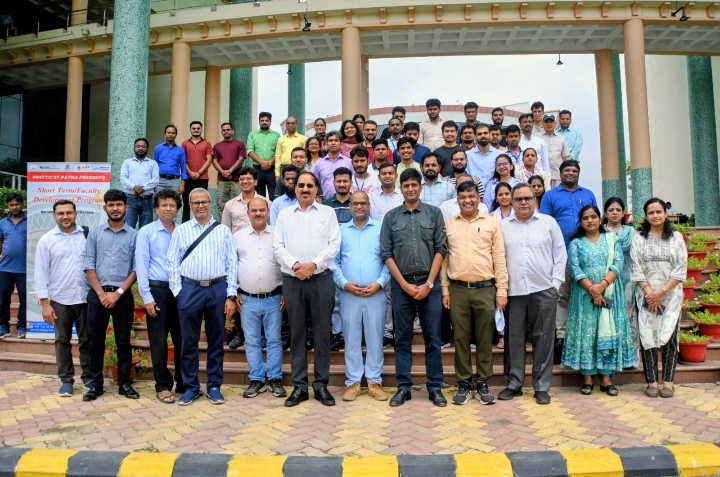
The 6-day Short-Term / Faculty Development Programme (FDP) on Mathematical Modeling of Diseases, being organized from July 6–11, 2026, at IIT Patna under the Malaviya Mission Teacher Training Centre (MMTTC), UGC, commenced today with a ceremonial lamp-lighting ceremony.
The inaugural session was graced by Prof. T. N. Singh, Director, IIT Patna, as the Chief Guest. Distinguished dignitaries present on the occasion included Dr. S. K. Parida, Programme Director, MMTTC, Dr. Prashant K. Srivastava, Coordinator of the Programme and Head, Department of Mathematics, Dr. Anup Kumar Keshri, Associate Dean (R&D), and Dr. Mahesh Kolekar, Head, Department of Electrical and Electronics Engineering, Prof. Jimson Mathew, Dean (SA) , Dr N K Tomar, Associate Dean (Resource) along with other esteemed guests.
The aim of this program is to provide participants with a comprehensive understanding of disease spread, prevention, and management through classical mathematical models and modern data-driven computational methods. A total of 35 participants are attending in person, while another 35 participants from various institutions across the country are participating virtually, reflecting the growing interest in this interdisciplinary domain.
In his address, Prof. T. N. Singh emphasized that the foundation of mathematical modeling in India is ancient and deep rooted. He referred to historical achievements, such as the precise calculation of the value of π (pi) mentioned in the ‘Shulba Sutras’ and Aryabhata’s remarkable estimation of the distance between the Earth and the Sun using geometric principles outlined in the ‘Surya Siddhanta’. He further emphasized that mathematical modeling plays a crucial role in understanding the spread of diseases, making effective decisions based on accurate information, and formulating prevention strategies.
This program will strengthen the knowledge, analytical skills, and research capabilities of faculty members, researchers, and academicians in the rapidly evolving interdisciplinary field of mathematical disease modeling.


